



Last updated: June 8, 2026
Build or buy an AI agent: decision tree for SMBs
You've heard that an AI agent can take over quoting, customer questions, or invoice processing. Now you have to choose: build it yourself with n8n or Python, use a no-code platform, or outsource it to a partner. This guide explains when each route fits your capacity, budget, and speed, with total cost breakdowns for Dutch SMEs. We'll cover what an AI agent actually is, when you need one versus a simple workflow, and how to calculate the real monthly expense of each approach, including developer time, infrastructure, and platform subscriptions.
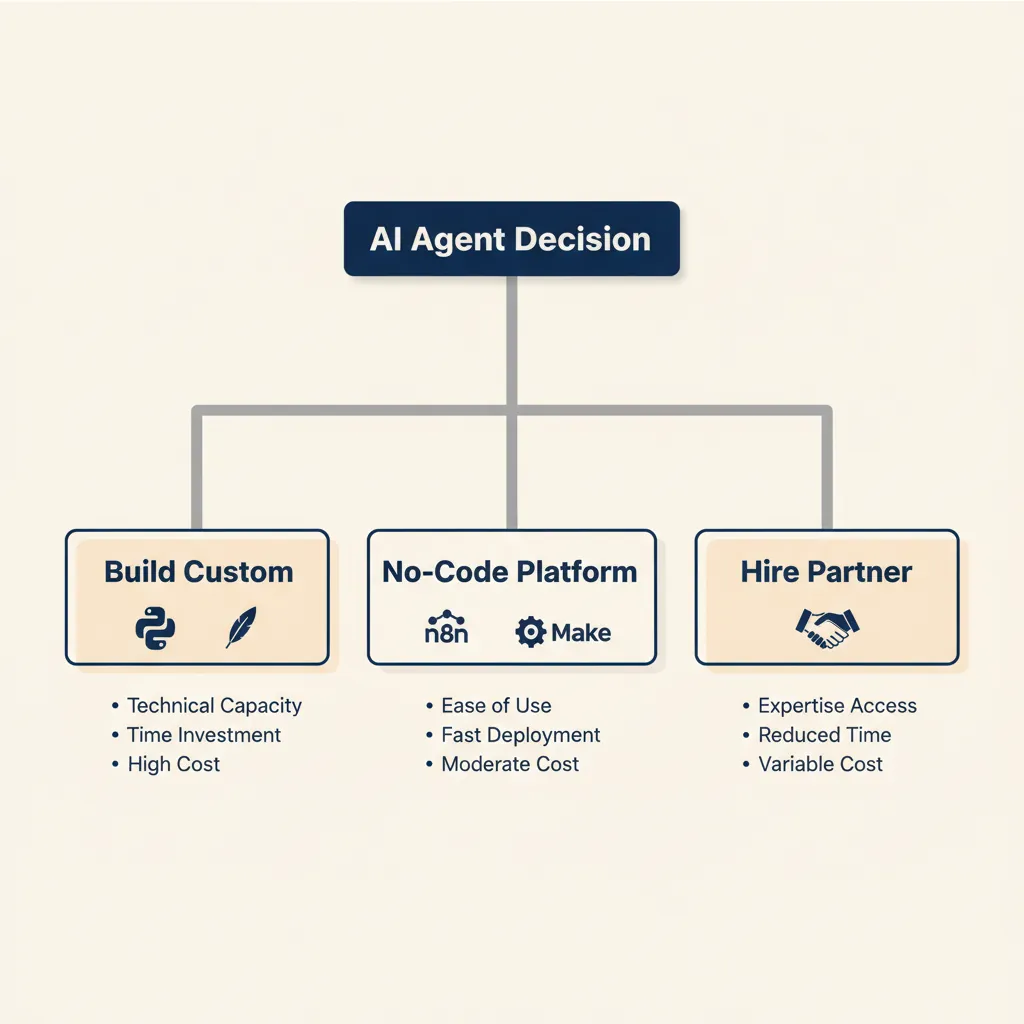
The search results for "ai agent zelf bouwen of laten bouwen" are dominated by international pricing comparisons for workflow tools like Zapier and Make, with zero Dutch-market context and no discussion of the build-versus-buy decision itself. This post fills that gap.
What an AI agent actually is (and why it's not a workflow)
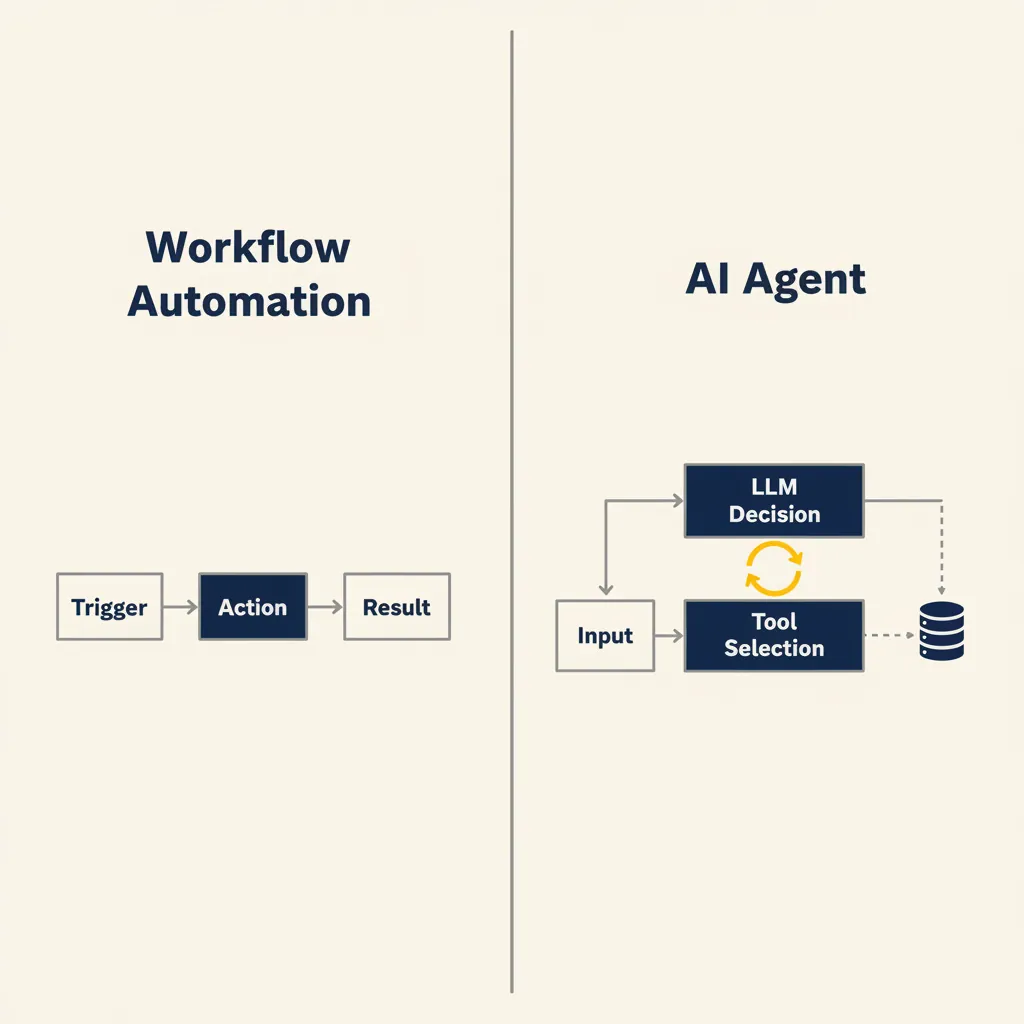
Most search results confuse workflow automation with AI agents. A workflow is a fixed sequence: if this happens, then do that. An AI agent uses an LLM to make decisions, retrieve context, and execute multi-step tasks autonomously. The difference matters when you're deciding what to build.
Workflow automation: if-this-then-that without decision logic
A workflow connects apps in a predefined chain. When a new row appears in Google Sheets, copy it to your CRM and send a Slack notification. The logic is static: you map every branch and condition in advance. Tools like Zapier, Make, and n8n excel at this. They're fast to set up, reliable, and cost-effective for automating repetitive SME processes that follow the same pattern every time.
For Dutch SMEs, common workflow examples include syncing Exact Online invoices to Moneybird, forwarding Mollie payment confirmations to your accounting system, or posting new webshop orders from WooCommerce into a Slack channel. These tasks don't require intelligence, just reliable plumbing between systems.
AI agent: an LLM that makes choices and calls tools
An AI agent adds a language model that interprets input, decides what to do next, and uses tools to complete the task. For example, a customer emails asking about an order. The agent reads the message, searches your order database, checks the shipping tracker, drafts a reply in your tone of voice, and sends it. You didn't hard-code every possible question; the agent figures it out.
Under the hood, an AI agent typically combines an LLM (ChatGPT, Claude, or a similar model), a vector database for context retrieval, and function-calling to trigger actions in your apps. Frameworks like LangChain and CrewAI handle the orchestration. The agent decides which tool to call based on the user's request, not a fixed flowchart.
When you actually need an agent: if the task requires understanding natural language, adapting to varied input, or making judgment calls, an agent fits. If the task is the same every time, a workflow is cheaper and simpler. In our business automation work, we see Dutch SMBs overbuying agents for tasks that a three-step Make scenario would solve.
Decision tree: build yourself, no-code platform, or hire a partner
Three paths exist, each with different trade-offs in technical skill, time-to-first-result, and ongoing maintenance. Pick based on your in-house capacity and how fast you need the solution live.
Build custom with code: when you have developer capacity
Building in Python with LangChain or CrewAI gives you full control. You own the logic, the data stays on your infrastructure, and you can integrate any API without waiting for a platform to add a connector. The cost is developer time: expect 40 to 80 hours for a first agent, depending on complexity, plus ongoing maintenance when APIs change or the model needs tuning.
This route makes sense if you have a developer on staff, the task involves proprietary logic that off-the-shelf tools can't handle, or you need to comply with strict data-residency rules that rule out third-party platforms. For example, a Dutch healthcare SME processing patient intake forms under GDPR might self-host everything to avoid a processor agreement with a US-based SaaS vendor.
No-code platform: speed and standard integrations
Platforms like n8n, Make, and Zapier let you build workflows and simple agents without writing code. You drag nodes onto a canvas, connect them, and the platform handles execution. According to the n8n documentation, the free self-hosted Community Edition includes unlimited executions and access to all 500+ integrations. Cloud plans start at €24/month for 2,500 executions on n8n Starter, €9/month on Make, or $19.99/month (billed annually) on Zapier Professional.
These platforms work well when your task uses standard apps (Gmail, Slack, HubSpot, Exact Online, Moneybird) and doesn't require deep custom logic. The trade-off: you're limited to the integrations the platform offers. If your Dutch accounting tool lacks a native connector, you'll need to build a custom API module, which brings back the developer-time cost.
Hire a partner: when time and support matter more
Outsourcing to a Dutch automation partner means you get a working solution in weeks, not months, and ongoing support when something breaks. Typical project cost for a mid-complexity agent (e.g. invoice processing with Exact Online, customer-support chatbot) ranges from €3,000 to €8,000, plus a monthly retainer of €200 to €500 for maintenance and adjustments. In our AI agent work, we deliver the first workflow live in two to four weeks, including GDPR-compliant hosting and a processor agreement.
This path fits when you lack in-house technical capacity, need the solution running quickly, or want someone else to handle updates when OpenAI changes an API or your CRM rolls out a new version. The cost is higher upfront, but you avoid the hidden expense of a developer spending three days debugging an integration that a specialist solves in an afternoon.
| Criterion | Build custom (code) | No-code platform | Hire a partner |
|---|---|---|---|
| Technical skill required | Python, API integration, LLM frameworks | Drag-and-drop, basic logic | None (partner handles it) |
| Time to first result | 4-8 weeks (developer time) | 1-2 weeks (standard integrations) | 2-4 weeks (including scoping) |
| Ongoing maintenance | Developer time for updates, security patches | Platform handles infra, you handle logic changes | Included in retainer |
| Best for | Unique logic, strict data control | Standard integrations, fast iteration | No IT team, need support |
Total cost of ownership for Dutch SMEs
The sticker price on a platform subscription hides the real monthly expense. Here's the breakdown for each approach, grounded in Dutch hourly rates and infrastructure costs.
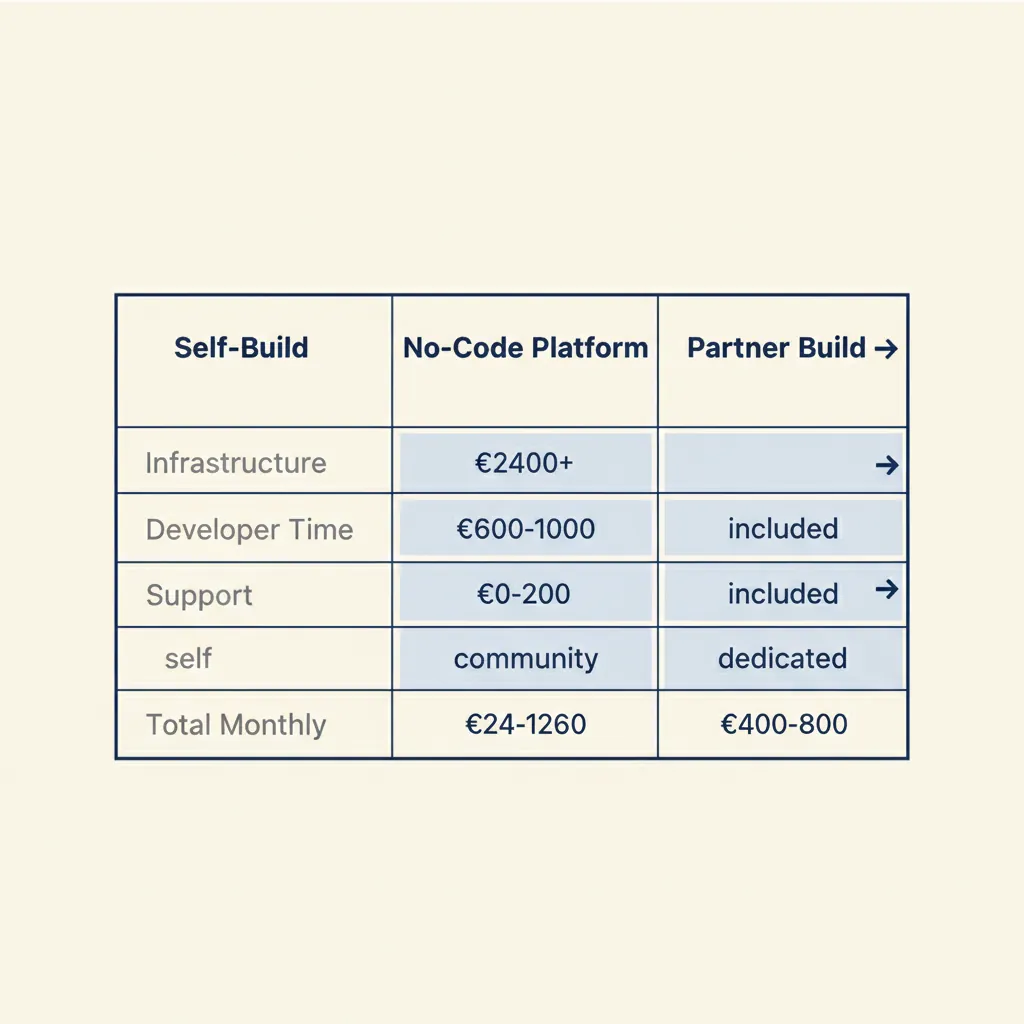
Self-hosting with code: Infrastructure (VPS, database, object storage) runs €200 to €400/month for a production-ready setup with backups and monitoring. Developer time to build the first agent: 40 to 80 hours at €75 to €125/hour (typical Dutch freelance rate for mid-level developers), so €3,000 to €10,000 upfront. Ongoing maintenance averages 4 to 8 hours per month (API updates, bug fixes, model tuning), adding €300 to €1,000/month. Total first-year cost: €7,000 to €22,000.
Cloud platform: n8n Starter costs €24/month for 2,500 executions, Pro is €60/month for 10,000 executions. Make starts at €9/month. Zapier Professional is $19.99/month (€18) for 750 tasks, but scales rapidly: a 10-step workflow on Zapier consumes 10 tasks, while the same workflow on n8n counts as 1 execution. For a Dutch SME running 5,000 workflow executions per month, n8n Pro (€60/month) is the most cost-effective. Add 8 to 16 hours of setup and configuration time (€600 to €2,000 one-time), plus 2 to 4 hours per month for adjustments (€150 to €500/month). Total first-year cost: €1,500 to €8,000.
Hiring a partner: Typical project cost for a mid-complexity agent (invoice processing with Exact Online, customer-support bot) is €3,000 to €8,000. Monthly retainer for maintenance and support: €200 to €500. The partner handles infrastructure, updates, and compliance. Total first-year cost: €5,400 to €14,000. In our business automation work, we see Dutch SMBs choosing this route when they value speed-to-market and want to avoid hiring a developer.
Worked example: A Dutch wholesale company wants to automate invoice processing from supplier emails into Exact Online. Self-hosting would cost €200/month infra + 60 hours build (€6,000) + 6 hours/month maintenance (€600/month) = €13,200 first year. n8n Pro (€60/month) + 12 hours setup (€1,200) + 3 hours/month tweaks (€300/month) = €5,580 first year. Hiring a partner: €5,000 project + €300/month retainer = €8,600 first year. The no-code platform wins on cost, assuming the company has someone who can handle basic workflow adjustments.
Running into this at your own business? We'll spend 30 minutes with you for free, no sales pitch. Book a free intro call
GDPR, NIS2, and data residency: compliance for AI agents
If your AI agent processes customer or employee data, you must comply with GDPR (known as AVG in the Netherlands). This means a processor agreement with any platform or partner, EU hosting for the data, and the right to explain automated decisions that significantly affect individuals. For Dutch SMEs in healthcare, financial services, or recruitment, these rules are non-negotiable.
Every cloud platform you use becomes a data processor under GDPR. You need a signed processor agreement (verwerkersovereenkomst) that specifies where data is stored, how it's secured, and what happens in a breach. n8n cloud instances are hosted in Frankfurt, Germany, which satisfies EU data-residency requirements. Zapier and Make also offer EU hosting, but you must verify the region setting in your account. If a platform stores data in the US without Standard Contractual Clauses, you're in violation.
NIS2, which became enforceable in the Netherlands on October 17, 2024, affects larger Dutch SMEs in critical sectors like healthcare, energy, transport, and digital infrastructure. If you fall under NIS2, you must log all automated decisions, implement incident-response procedures, and document supply-chain risks. An AI agent that processes patient appointments or energy-grid data requires audit logs, access controls, and a documented risk assessment. Most no-code platforms don't include NIS2-compliant logging out of the box; you'll need to add it yourself or work with a partner who handles it.
ISO 27001 certification matters when you bid on tenders or work with larger clients who require it in their contracts. If your AI agent handles data for a client who demands ISO 27001, either host it on certified infrastructure (AWS, Google Cloud, Azure all offer ISO-certified regions) or hire a partner with the certification. Self-hosting without ISO 27001 will block you from those contracts.
When choosing a platform or partner, ask three questions upfront: Where is the data stored (EU or non-EU)? Do you provide a signed processor agreement? Can you generate audit logs for every automated decision? If the answer to any is unclear, walk away. The Autoriteit Persoonsgegevens (Dutch DPA) has fined SMEs for GDPR violations; the risk is real.
What most automation partners get wrong (and how to spot it)
The most common mistake we see in Dutch SME automation projects: the partner sells you a platform (n8n, Make, Zapier) without first mapping your actual approval process, data quality, or integration gaps. The tool works perfectly in the demo. Then you go live and discover that no one documented who approves quotes above €5,000, your product database has duplicate SKUs, or the API connector for your legacy ERP doesn't support the field you need. The workflow stalls, and you're left with a half-built system and a bill.
This happens because many agencies are platform resellers, not process consultants. They're incentivized to get you onto a subscription quickly, not to spend three hours mapping your current workflow on a whiteboard. The result: the tool does what it's supposed to, but the business process underneath isn't ready for automation. You automate a broken process, and it breaks faster.
How to spot this before you sign: ask a prospective partner to walk through your current process on paper before they demo any tool. If they jump straight to "we'll build this in Make" without asking who does what today, how exceptions are handled, or where the data lives, that's a red flag. A good partner will spend the first meeting asking questions, not showing you their portfolio. In our AI consultancy work, we always start by documenting the as-is process, identifying bottlenecks, and cleaning the source data before we touch a platform.
Another anti-pattern: promising that the AI agent will "learn" from your data without explaining what that means. An LLM doesn't learn from your invoices by osmosis; you need to structure the data, embed it in a vector database, and tune the retrieval logic. If a partner says "just upload your files and the agent will figure it out," you're buying vaporware. Ask them to explain the RAG pipeline, the embedding model, and how they'll handle documents that don't fit the expected format. If they can't answer, they don't know how to build it.
Finally, watch for partners who ignore compliance. If they don't mention GDPR, processor agreements, or data residency in the first conversation, they either don't know the rules or don't care. Either way, you're liable when the Autoriteit Persoonsgegevens comes asking. A competent partner will bring up compliance unprompted and show you where the data will be stored before you sign anything.
Conclusion
Building yourself works when you have developer capacity and need unique logic that off-the-shelf tools can't handle. No-code platforms like n8n and Make give you speed for standard integrations and cost less than hiring a developer for simple workflows. Hiring a partner fits when you want a working solution in weeks, lack in-house IT staff, and value ongoing support over upfront cost savings.
Calculate the total cost: infrastructure, developer hours at €75 to €125/hour, platform subscription, and monthly maintenance. Check that your partner maps your process before they sell you a tool, and verify that they handle GDPR compliance (processor agreement, EU hosting, audit logs) from day one. The cheapest option upfront often costs more when you factor in the time spent fixing a workflow that wasn't designed for your actual business process.
For a related angle, see our post on n8n vs Make for SMB: which platform fits your team?.
Frequently asked questions
What does it cost to build an AI agent yourself with Python and LangChain?
Expect 40 to 80 hours of developer time at €75 to €125/hour (€3,000 to €10,000 upfront), plus €200 to €400/month for infrastructure (VPS, database, backups) and 4 to 8 hours per month for maintenance (€300 to €1,000/month). Total first-year cost: €7,000 to €22,000.
Can I build an AI agent without programming knowledge?
Yes, using a no-code platform like n8n, Make, or Zapier. You drag nodes onto a canvas and connect them. These platforms work well for standard integrations (Gmail, Slack, Exact Online, Moneybird) but are limited to the connectors they offer. If your tool lacks a native integration, you'll need custom API work, which requires a developer.
Which no-code platforms support Dutch tools like AFAS and Exact Online?
n8n and Make both offer native connectors for Exact Online and Moneybird. AFAS support varies: n8n has a community-built AFAS node, but it's not officially maintained. If you need deep AFAS integration, expect to build a custom API module or hire a partner who has done it before.
Do I need a processor agreement if I use n8n or Make for customer data?
Yes. Under GDPR (AVG in the Netherlands), any platform that processes customer or employee data on your behalf is a data processor, and you must have a signed processor agreement (verwerkersovereenkomst). n8n and Make both provide standard agreements; request one before you go live. Also verify that the data is stored in the EU (Frankfurt region for n8n cloud).
When is it cheaper to hire a partner than to build an AI agent yourself?
When you lack in-house developer capacity or the hidden cost of your time exceeds the project fee. If your developer would spend 60 hours at €100/hour (€6,000) plus ongoing maintenance, and a partner quotes €5,000 with a €300/month retainer, the partner is cheaper. Also factor in speed: a partner delivers in two to four weeks; a first-time build can take two to three months.
What's the difference between workflow automation and an AI agent?
Workflow automation is a fixed sequence: if this happens, then do that. You define every step and condition in advance. An AI agent uses an LLM to interpret input, decide what to do next, and call tools to complete the task. If the task is the same every time, use a workflow. If it requires understanding natural language or adapting to varied input, use an agent.
Sources
Curious what AI can do for your business?
We listen, think along, and quickly deliver something that works. No obligations, no pressure.