



Last updated: June 1, 2026
Calculate automation ROI: formula, benchmarks, hidden costs
You know automation saves time, but your accountant or business partner wants to see when the investment pays back. Most online calculators give you a rough number but skip the hidden costs that can blow your budget by 30 to 40 percent. This guide walks you through a step-by-step ROI formula you can apply yourself, realistic payback benchmarks for Dutch SMEs, and the line items (change management, training, ongoing maintenance) that most ROI models forget. We'll also cover the Dutch tax breaks (WBSO, KIA) that lower your net investment and the fiscal angles your bookkeeper needs to track.
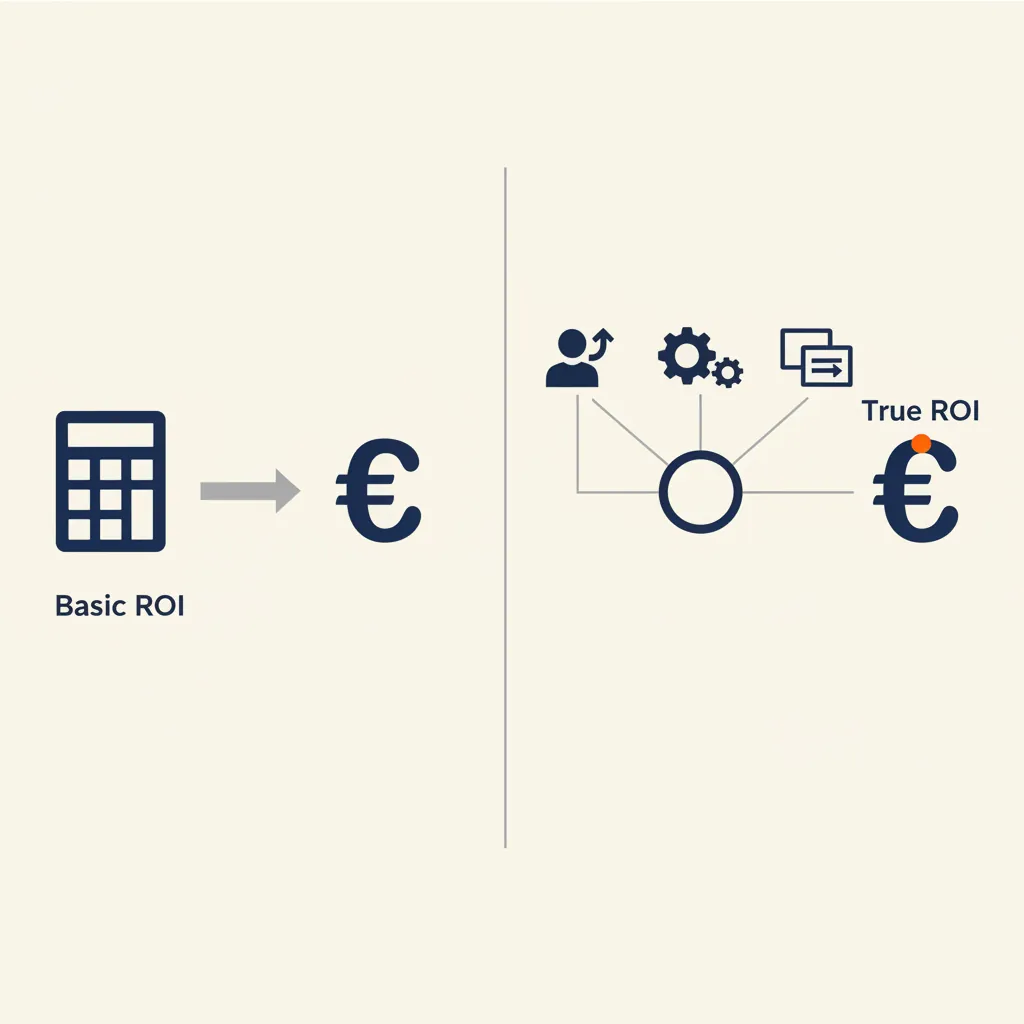
The basic ROI formula for automation projects
Return on investment is straightforward: take the savings you gain, subtract the total cost, then divide by the cost. Express it as a percentage or as a payback period in months. For automation in SMEs, savings usually mean labor hours you no longer spend on manual tasks, multiplied by the hourly cost of the person doing that work. Costs split into two buckets: CAPEX (one-time build, licenses, integrations) and OPEX (monthly subscriptions, maintenance, training).
What counts as savings
Track hours saved per week, not vague productivity gains. If your team currently spends 8 hours a week copying data from email into your accounting system, and an n8n workflow cuts that to zero, you save 8 × 52 = 416 hours per year. Multiply by the loaded hourly rate (salary plus employer taxes, typically €30 to €50 for administrative staff in the Netherlands) to get your annual labor savings. Other quantifiable gains include faster order processing (revenue you capture sooner), fewer errors (rework costs you avoid), and customer-support capacity you free up for higher-value work.
CAPEX versus OPEX in automation
CAPEX covers the upfront investment: building the workflow, buying perpetual licenses (rare these days), integrating with your existing systems like AFAS or Exact Online, and any hardware if you self-host. OPEX includes monthly SaaS fees (n8n cloud, Make, Zapier), ongoing support, and the hours your team spends tweaking workflows when your process changes. Dutch SMEs often prefer OPEX-heavy models because you can expense them immediately rather than depreciating over multiple years, and you avoid a large cash outlay. In our business automation work, we see clients choose low-code platforms (n8n, Make) precisely because the CAPEX stays low: you pay for build hours once, then a predictable monthly platform fee.
Payback period: when you break even
Divide total first-year cost by annual savings to get payback in years, or multiply by 12 for months. A 6-month payback is common for high-volume administrative workflows (invoice processing, order entry). A 12 to 18-month payback is realistic for more complex projects like AI-powered customer support or multi-system integrations. If your payback stretches beyond 24 months, the process may be too small or too unstable to justify automation right now.
Hidden costs that distort your ROI calculation
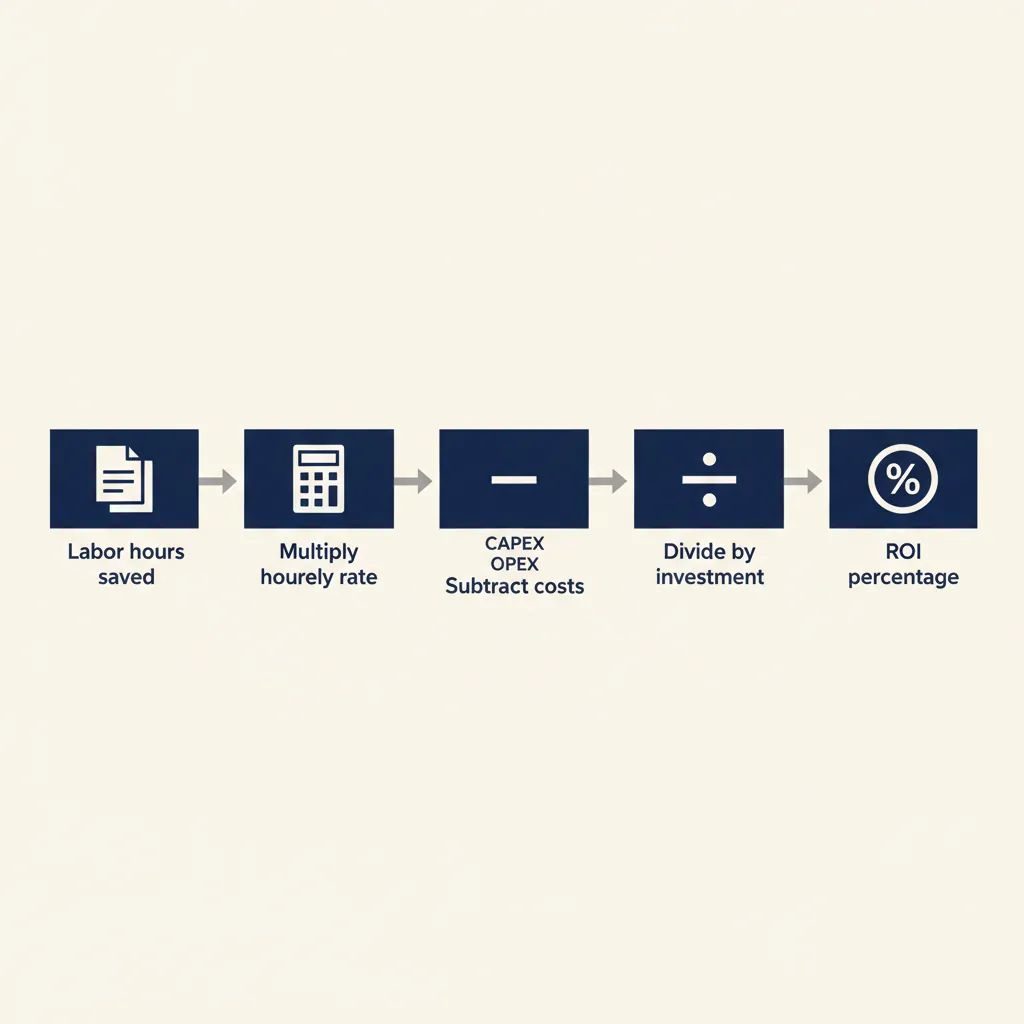
Most ROI calculators only count licenses and developer hours. The projects we deliver for Dutch SMBs show that change management, training, and year-two maintenance together add 20 to 40 percent on top of the initial quote. If you skip these line items, your real payback will be months longer than your spreadsheet predicts.
Change management and training days
Your team needs to learn the new workflow, unlearn the old habits, and trust that the automation won't lose data. Budget 1 to 3 days of training per person who touches the process, plus follow-up sessions when questions arise. For a five-person team, that's 5 to 15 person-days at their daily rate. Change resistance is real: if the workflow owner feels bypassed, they'll work around the automation and your ROI evaporates. Include stakeholder workshops in your project plan and count those hours as cost.
Maintenance, updates, and integration drift
APIs change, your business rules evolve, and platforms release breaking updates. Plan for 5 to 10 hours per quarter to keep workflows healthy. If you built on n8n or Make, minor tweaks are fast; if you hard-coded integrations, maintenance balloons. The second-year cost is often half the first-year build cost, yet many ROI models assume zero ongoing expense. Track this in your OPEX budget from day one.
Tax relief: WBSO, KIA, and MIA for automation
Dutch SMEs can claim WBSO (R&D tax credit) if the automation project involves technical uncertainty or innovation, for example building a custom AI agent or integrating systems that lack standard connectors. WBSO cuts your effective labor cost by up to 40 percent. KIA (small-scale investment allowance) and MIA (environmental investment allowance) apply when you buy qualifying assets; automation hardware or energy-saving server infrastructure may qualify. Check with your accountant whether your project meets the criteria. These credits lower your net CAPEX, shortening payback by several months. The Belastingdienst (Dutch tax authority) publishes depreciation tables and R&D definitions you can reference.
Running into this at your own business? We'll spend 30 minutes with you for free, no sales pitch. Book a free intro call
ROI benchmarks by automation type and sector
A quote-generation workflow delivers different numbers than an AI agent answering customer emails. We break down realistic payback periods and savings for the three most common automation categories, plus sector examples from construction, hospitality, administrative services, and e-commerce.
RPA versus low-code workflows versus AI agents
| Type | Typical payback | Best for | Example saving |
|---|---|---|---|
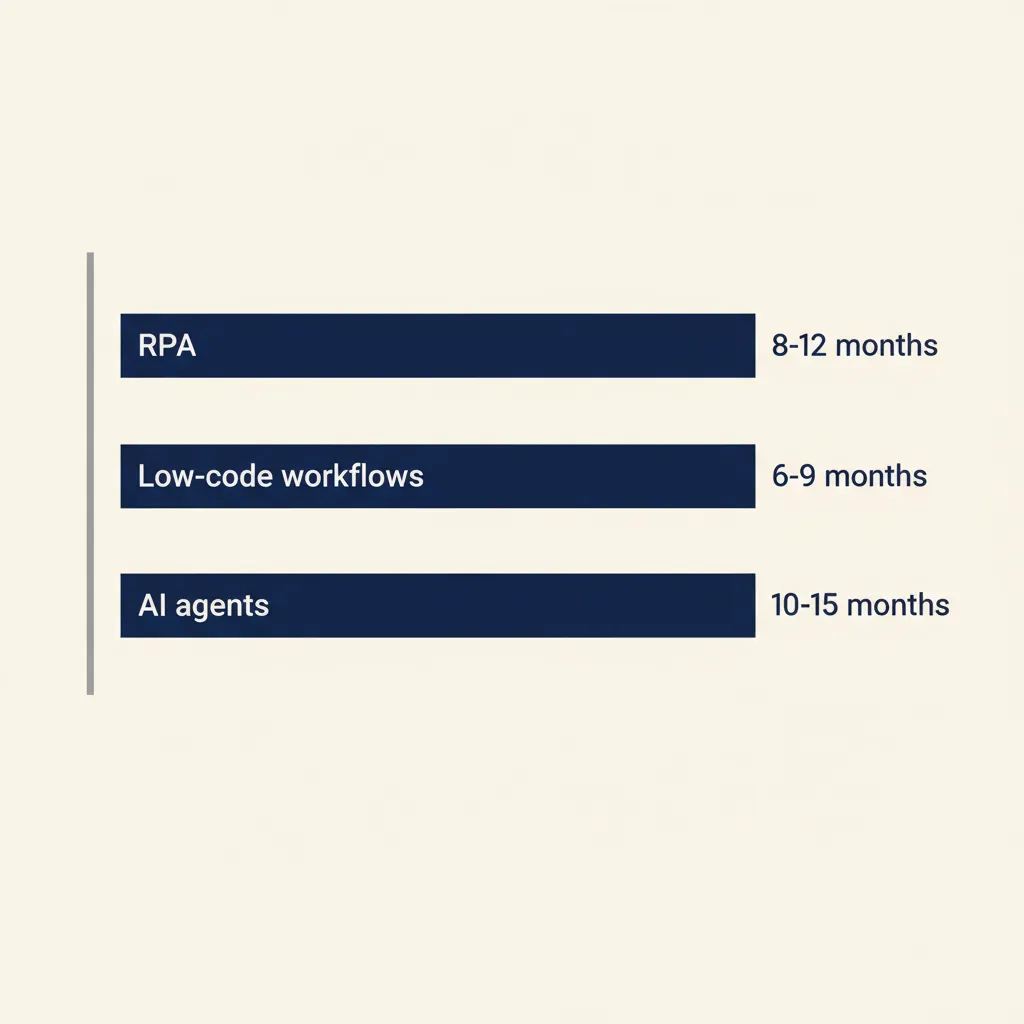
| RPA (UiPath, Automation Anywhere) | 9-15 months | High-volume, rule-based desktop tasks (data entry, report generation) | 200-400 hours/year per bot |
| Low-code workflows (n8n, Make, Zapier) | 3-9 months | Connecting cloud tools, triggering actions across systems | 4-12 hours/week saved per workflow |
| AI agents (custom GPT, AI-based assistants) | 6-12 months | Interpreting unstructured input, answering customer questions, drafting content | 50-70% reduction in first-response time |
RPA shines when you need to automate legacy desktop software that has no API. The licensing and infrastructure cost is higher, so payback takes longer. Low-code platforms win on speed and cost for cloud-to-cloud integrations: you can deploy a workflow in days, and monthly fees stay under €100 for most SME use cases. AI agents add the most value when the task requires understanding context or natural language, but you need clean training data and a well-defined scope to avoid runaway token costs.
Sector examples: construction, hospitality, administration, e-commerce
- Construction: Automating quote generation from BIM models and material price lists saves estimators 6 to 10 hours per week. Payback is typically 4 to 6 months when you integrate with planning tools and send quotes directly to clients via email or portal.
- Hospitality: Reservation confirmations, staff-shift notifications, and inventory reordering workflows cut administrative overhead by 8 to 12 hours per week for a mid-sized restaurant or hotel. Payback in 3 to 5 months, especially when you connect your POS to Exact Online or Moneybird for real-time bookkeeping.
- Administrative services: Bookkeeping firms and consultancies use n8n or Make to pull invoices from client email, match them to purchase orders, and push approved lines into AFAS or Snelstart. A single workflow saves 10 to 15 hours per week across multiple clients, with payback under 6 months.
- E-commerce: Order-to-fulfillment automation (web-shop to warehouse to shipping carrier) plus inventory sync across marketplaces saves 15 to 20 hours per week for shops processing 200+ orders weekly. Payback is 4 to 8 months, faster if you reduce stockouts and overselling penalties.
When evaluating our AI consultancy for your sector, we map your highest-volume processes first and calculate ROI for each before you commit to building anything.
When automation delivers no ROI (and what to do instead)
Not every process justifies the investment. Three warning signs tell you to wait or redesign the process before automating: the task happens fewer than twice a week, the rules change every month, or the process depends on judgment calls that even your team can't codify. Automating unstable or low-volume work locks in a bad process and wastes money on maintenance.
If the process runs fewer than 100 times per year and takes under 15 minutes each time, the total annual saving is around 25 hours. At a €40 loaded rate, that's €1,000 per year. A workflow that costs €2,000 to build won't pay back for two years, and by then your process may have changed. Better to standardize the manual steps with a checklist and revisit automation when volume grows.
When the process involves too many exceptions (more than 20 percent of cases need human override), automation becomes a half-solution. You still need someone monitoring edge cases, so your labor saving shrinks. In these situations, automate the high-confidence 80 percent and leave the exceptions to your team. Measure ROI only on the automated portion.
If your process isn't documented or your team disagrees on the steps, fix that first. Automating an unclear process amplifies confusion and creates rework. Spend a week mapping the current state with your team, agree on the target state, then calculate ROI. This delay saves you from building the wrong thing.
For a related angle, see our post on AI Agents for SMBs: Cost, ROI, and Practical Use Cases.
Frequently asked questions
What is a realistic payback period for automation in Dutch SMEs?
Most low-code workflows (n8n, Make, Zapier) connecting cloud tools pay back in 3 to 9 months. AI agents and complex RPA projects typically take 6 to 12 months. If payback stretches beyond 18 months, the process volume or savings may be too small to justify automation right now.
How do I calculate the labor cost I save with automation?
Count the hours per week your team currently spends on the manual task, multiply by 52 weeks, then multiply by the loaded hourly rate (salary plus employer taxes, typically €30 to €50 for administrative roles in the Netherlands). That gives you annual labor savings in euros.
Which Dutch tax breaks apply to automation projects?
WBSO (R&D tax credit) applies when your project involves technical uncertainty or innovation, cutting effective labor cost by up to 40 percent. KIA (small-scale investment allowance) and MIA (environmental investment allowance) may apply to qualifying hardware or energy-saving infrastructure. Check eligibility with your accountant and the Belastingdienst definitions.
When is a process too small to automate?
If the task happens fewer than 100 times per year and takes under 15 minutes each time, total annual savings are around 25 hours. At a €40 loaded rate, that's €1,000 per year. A workflow costing €2,000 to build won't pay back for two years. Standardize manually with a checklist and revisit automation when volume grows.
What is the difference between CAPEX and OPEX in automation?
CAPEX covers upfront costs like building the workflow, buying perpetual licenses, and integrating with your existing systems. OPEX includes monthly SaaS fees, ongoing support, and the hours your team spends maintaining or tweaking workflows. Most Dutch SMEs prefer OPEX-heavy models because you can expense them immediately and avoid large cash outlays.
How do I account for maintenance and training in my ROI calculation?
Budget 1 to 3 training days per person who touches the new workflow, plus 5 to 10 hours per quarter for ongoing maintenance (API updates, rule changes, troubleshooting). These costs typically add 20 to 40 percent on top of the initial build quote. Include them in your OPEX from day one, or your real payback will be months longer than your spreadsheet predicts.
Sources
Curious what AI can do for your business?
We listen, think along, and quickly deliver something that works. No obligations, no pressure.