



Last updated: May 13, 2026
AI for webshops: practical tools and ROI for SMBs
You've heard that AI can boost your conversion rate and save hours per week, but you don't know where to start or which tools work with your Shopify, WooCommerce, or Lightspeed setup. This article shows you which AI applications already deliver ROI for Dutch webshops, which tools understand Dutch, and how to implement them GDPR-compliant without an IT department. Machine learning powers product recommendations, natural language processing (NLP) handles customer queries in Dutch, and generative AI writes product descriptions and marketing copy. Kunstmatige intelligentie in ecommerce is no longer a future promise: according to BigCommerce, 78% of companies now use generative AI in at least one part of their business, and 95% of brands using AI report a strong ROI.
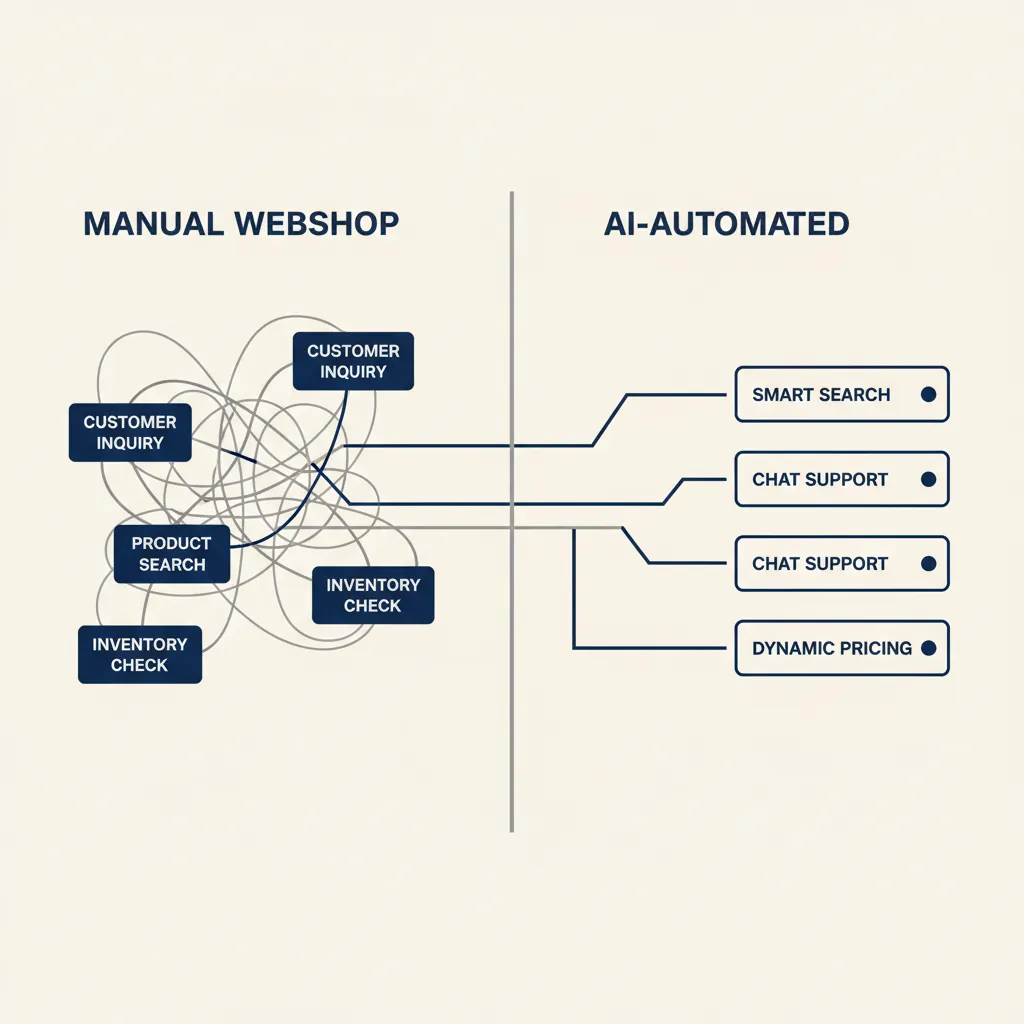
| AI application | What it does | ROI signal | Dutch platform fit |
|---|---|---|---|
| Smart search | Understands typos, synonyms, intent | Fewer zero-result searches, higher conversion | WooCommerce, Shopify, Lightspeed |
| Customer-support chatbot | Answers FAQs, tracks orders, escalates complex cases | Cuts response time from hours to seconds | Integrates with Mollie, Exact Online, Moneybird |
| Product recommendations | Suggests related items, upsells, cross-sells | Lifts average order value 10-20% | Works on all major platforms |
| Dynamic pricing | Adjusts prices by customer segment, stock level, competitor | Margin improvement, faster inventory turn | B2B webshops on AFAS, Exact Online |
What AI for webshops actually does (and what it doesn't)
AI in webshops automates three things: customer interaction (chatbots, recommendations), data analysis (inventory forecasting, pricing optimization), and content (product descriptions, SEO copy). Behind these applications sit three core technologies: machine learning, natural language processing, and generative AI. Understanding which does what helps you pick tools that fit your budget and platform.
Machine learning for product recommendations and search results
Machine learning models analyze past behavior (clicks, purchases, time on page) to predict what a customer wants next. When someone views a pair of running shoes, the model suggests socks, insoles, or related styles based on patterns from thousands of previous sessions. For Dutch webshops running on Shopify or WooCommerce, plugins like Nosto or Clerk.io connect to your catalog and start learning from day one. The ROI shows up in average order value: webshops with recommendation engines typically see a 10-20% lift. Expect a 4-6 week learning period before the suggestions feel accurate; the model needs data to find patterns.
Natural Language Processing for Dutch customer service
NLP lets a chatbot understand what a customer means, not just match keywords. A Dutch customer typing "wanneer komt mijn pakketje" or "waar is mijn bestelling" triggers the same order-tracking flow, even though the phrasing differs. Most off-the-shelf chatbots fail here because they're trained on English. GPT-based models and Claude handle Dutch well, but you still need to train them on your specific return policy, shipping times, and product catalog. In the custom GPT work we deliver for Dutch SMEs, we see that 8 out of 10 chatbot failures trace back to unclear knowledge-base documents, not the model. Clean your FAQ and policy pages first.
Generative AI for product descriptions and marketing copy
Generative AI writes text from a prompt. Feed it a product title, specs, and brand tone, and it drafts a description in seconds. For webshops with hundreds or thousands of SKUs, this cuts description-writing time from hours to minutes. Tools like Jasper, Copy.ai, or a custom GPT trained on your existing catalog handle Dutch fluently. The catch: generic AI copy sounds generic. You'll want to edit for brand voice and add details the model can't infer (fabric feel, fit notes, use cases). Treat generative AI as a first-draft tool, not a publish-and-forget solution.
What this means for you: Pick the AI application that solves your biggest time drain first, whether that's answering the same customer questions, writing product copy, or surfacing the right products to browsers.
Four AI applications Dutch webshops use right now
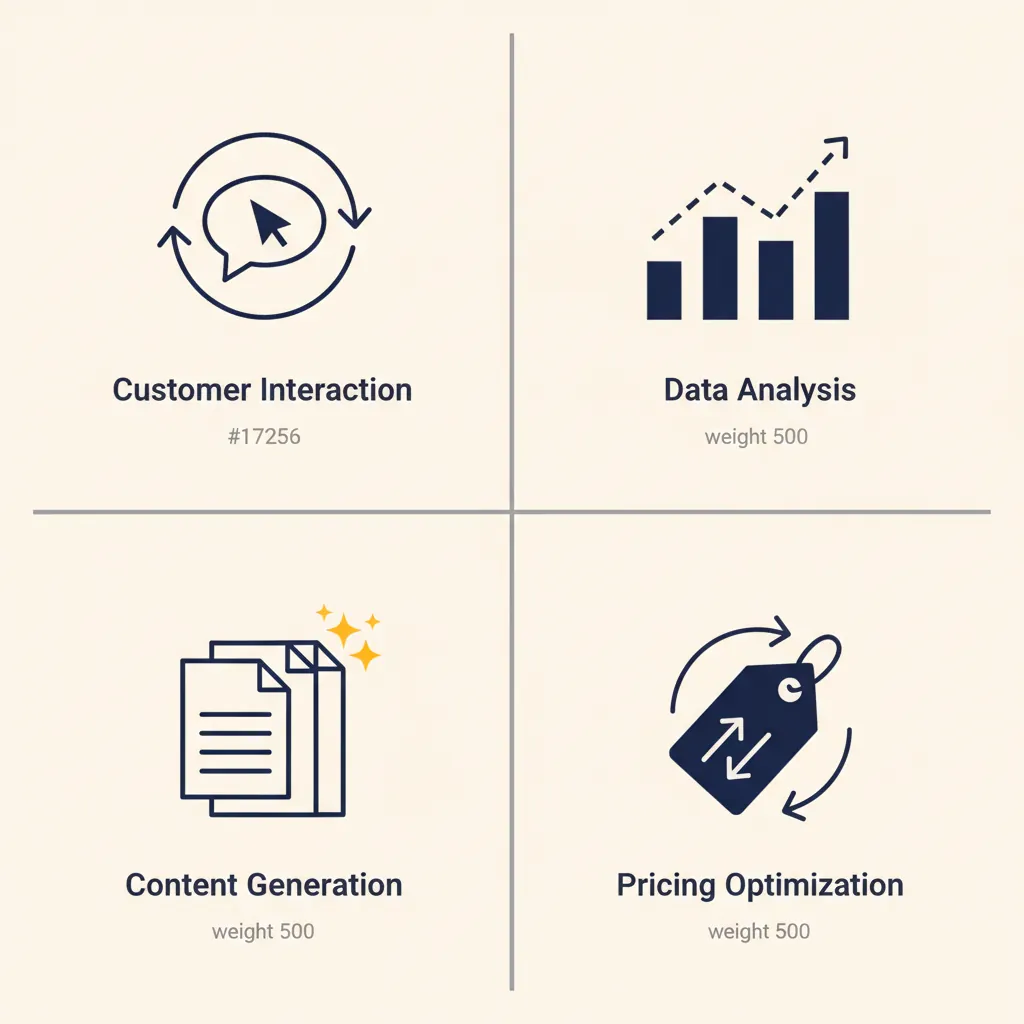
These four AI functions deliver measurable ROI and integrate with the platforms and payment providers Dutch SMEs already run. Each example names tools that work with Shopify NL, WooCommerce, Lightspeed, or CCV Shop, and shows where you connect Mollie, AFAS, Exact Online, or Moneybird.
AI search that understands Dutch language and typos
Standard webshop search matches exact keywords. A customer typing "broek" won't find products tagged "pantalon," and "hardloopschoenen" won't surface "running shoes." AI-powered search uses NLP to map synonyms, correct typos, and understand intent. Tools like Algolia, Klevu, or Doofinder plug into WooCommerce and Shopify and index your catalog in Dutch. The result: fewer zero-result searches and higher conversion on search traffic. For a 500-SKU fashion webshop, we've seen search-driven conversion jump 15-25% after switching from default platform search to an AI layer.
Chatbots for customer service: when they work and when they don't
A customer-support chatbot handles repetitive questions (order status, return policy, sizing) so your team can focus on complex cases. The bot lives on your webshop, pulls data from your order system (via Mollie or your platform API), and escalates to a human when it can't help. Chatbots work well for: tracking orders, explaining return windows, and pointing customers to the right product category. They fail when: the question requires judgment ("which color suits me?"), the knowledge base is incomplete, or the bot's tone feels robotic. In the AI agent projects we build for Dutch webshops, the single biggest success factor is a well-organized FAQ and clear escalation rules. If you don't have those, the chatbot will frustrate customers instead of helping them.
Product recommendations and personalization
Recommendation engines show "customers who bought X also bought Y" blocks, personalized homepages, and cart upsells. Machine learning models analyze purchase history, browsing behavior, and product attributes to suggest items a customer is likely to buy. Shopify apps like LimeSpot or Rebuy, and WooCommerce plugins like Recom.ai, connect to your catalog and start learning immediately. The ROI is straightforward: higher average order value and more items per transaction. Expect to see results within 6-8 weeks as the model gathers enough session data to make accurate predictions.
Dynamic pricing and customer-specific prices for B2B
Dynamic pricing adjusts product prices based on stock level, competitor pricing, customer segment, or purchase volume. For B2B webshops, this often means showing different prices to different customer groups: wholesale buyers see lower prices than retail, and high-volume accounts get automatic discounts. Tools like Omnia or Prisync pull competitor data and adjust your prices in real time, while ERP integrations (AFAS, Exact Online) let you sync customer-specific pricing rules from your back office to your webshop. Dutch B2B webshops in construction materials, wholesale food, and office supplies use this to automate quote generation and margin management. The payback period is typically 8-12 weeks, measured in margin improvement and reduced manual quoting time.
What this means for you: Start with the AI application that solves your biggest bottleneck, whether that's customer questions piling up, low conversion on search traffic, or manual quoting eating hours every day.
Running into this at your own business? We'll spend 30 minutes with you for free, no sales pitch. Book a free intro call
Why standard AI tools often fail in Dutch webshops (and what works instead)
Most international AI tools are trained on English and don't understand Dutch search intent, customer phrasing, or language nuances. A chatbot that doesn't recognize "retourneren" or a search engine that can't link "broek" and "pantalon" frustrates customers instead of helping them. The fix: use NLP models that support Dutch (GPT-based models, Claude), train a custom GPT on your product catalog and customer questions, or build a tailored AI agent that connects to your specific data sources. Off-the-shelf SaaS tools work when your catalog and customer base are small and your questions are generic. When your business has sector-specific terminology (construction materials, medical supplies, food ingredients), a custom-trained model delivers better results. We design and build these custom GPT solutions for Dutch SMEs, training the model on your existing FAQ, return policy, and product data so it answers in your brand voice and understands your customers' phrasing. The first working version is typically live in 2-4 weeks.
What this means for you: Test a standard tool first if your catalog and questions are straightforward; move to a custom-trained model when generic AI starts giving wrong or irrelevant answers.
GDPR-compliant AI implementation: consent, data storage, and processor agreements
AI in webshops processes personal data (search behavior, purchase history, chat transcripts), so GDPR compliance (known in the Netherlands as AVG) is mandatory. You need explicit consent for any AI application that profiles customers or makes automated decisions affecting them (personalized pricing, credit checks). For chatbots and recommendations, legitimate interest often covers the legal basis, but you must document it in your privacy policy. Data storage matters: if you use OpenAI, Google Cloud, or another US-based provider, check that they offer EU data residency and sign a data processing agreement (verwerkersovereenkomst). Tools like n8n (self-hosted or EU cloud) and Make (EU region available) let you keep data in the Netherlands or EU. Your privacy policy must explain which AI applications you use, what data they process, and how customers can opt out or request deletion. For Dutch SMEs without a legal team, the Dutch Data Protection Authority offers templates and guidance. The practical checklist: document your legal basis, sign processor agreements with every AI vendor, store data in the EU when possible, and update your privacy policy before you go live.
What this means for you: GDPR compliance isn't optional; budget time to document your legal basis, sign processor agreements, and update your privacy policy before launching any AI feature.
Step-by-step: implementing AI in your webshop without an IT department
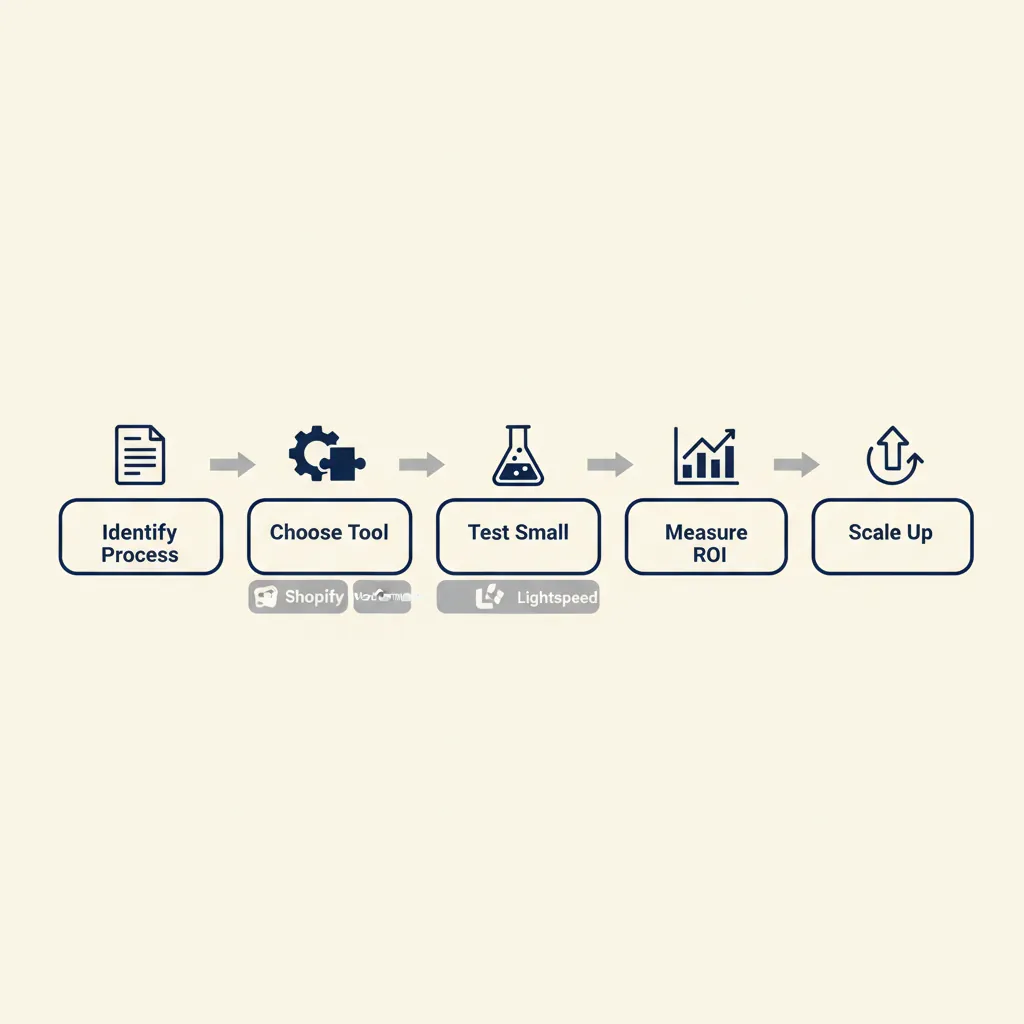
Start with one process that costs you the most time: answering customer questions, writing product descriptions, or manually adjusting prices. Pick a tool that integrates with your current platform (Shopify, WooCommerce, Lightspeed) and test it on a small subset of your catalog or customer base. Measure ROI in hours saved or conversion lift, then scale what works. For example, if customer emails pile up, start with a chatbot trained on your ten most common questions. Use a no-code platform (Make, Zapier, n8n) to connect the chatbot to your order API (Mollie, your webshop platform) and your CRM. Test for two weeks, track how many questions the bot answers without escalation, and expand the knowledge base as you go. If you're writing hundreds of product descriptions, train a custom GPT on 20 existing descriptions that match your brand voice, generate drafts for the rest, and edit them before publishing. The pattern is always the same: small scope, clear success metric, iterate. When the process touches multiple systems (webshop, ERP, accounting, CRM), our business automation service connects them end-to-end so data flows automatically and you're not copy-pasting between tools.
What this means for you: Don't try to automate everything at once; pick one high-cost process, prove the ROI, then expand.
AI for webshops delivers ROI when you start with one concrete process, choose a tool that understands Dutch and integrates with your existing systems, and implement it GDPR-compliant. Begin small, measure results in hours saved or conversion lift, and scale what works. The webshops that succeed with AI treat it as a tool to solve a specific problem, not a magic solution for everything.
For a related angle, see our post on AI for business: practical guide for Dutch SMEs.
Frequently asked questions
What does AI implementation cost for a Dutch SME webshop?
A plug-and-play chatbot or recommendation engine starts around €50-€200 per month depending on traffic and features. A custom-trained GPT or AI agent built on your catalog and integrated with your ERP (AFAS, Exact Online, Moneybird) typically costs €3,000-€8,000 for the first build, then €100-€300 monthly hosting and maintenance. Payback period is usually 8-16 weeks, measured in hours saved or conversion lift.
Which AI tools work with Shopify, WooCommerce, and Lightspeed?
For chatbots: Tidio, Zendesk, or a custom GPT via API. For search: Algolia, Klevu, Doofinder. For recommendations: LimeSpot, Rebuy (Shopify), Recom.ai or WooCommerce Product Recommendations (WooCommerce). For dynamic pricing: Omnia, Prisync. All integrate via plugin or API; most support Dutch language when configured correctly.
How long before AI investments pay back?
Chatbots and recommendation engines typically show ROI in 6-12 weeks (measured in hours saved or conversion lift). Dynamic pricing and custom AI agents take 8-16 weeks because they require more setup and learning time. Start with a small scope and clear success metric so you can measure payback accurately.
Can I use customer data for AI without separate consent?
It depends on the AI application. Chatbots and product recommendations usually fall under legitimate interest (you don't need separate consent), but you must document it in your privacy policy and offer an opt-out. Personalized pricing or automated credit decisions require explicit consent under GDPR. When in doubt, consult the Dutch Data Protection Authority or a GDPR advisor.
Which AI chatbots understand Dutch well enough for customer service?
GPT-based models (via OpenAI API or custom GPT) and Claude handle Dutch fluently. Off-the-shelf tools like Tidio and Zendesk support Dutch but need careful training on your FAQ and product catalog. In our experience, the model matters less than the quality of the knowledge base you feed it: a well-organized FAQ in Dutch beats a powerful model trained on messy or incomplete data.
Can I implement AI without a developer or IT department?
Yes, for simple use cases. Plug-and-play tools (Tidio chatbot, LimeSpot recommendations, Algolia search) install via plugin and need no code. When you want to connect AI to your ERP, CRM, or accounting software (AFAS, Exact Online, Moneybird), you'll need a no-code platform (Make, Zapier, n8n) or a partner who builds the integration. We handle the full build for Dutch SMEs so you don't need in-house developers.
Sources
Curious what AI can do for your business?
We listen, think along, and quickly deliver something that works. No obligations, no pressure.