

Last updated: May 15, 2026
AI for HR departments: what to automate in Dutch SMBs
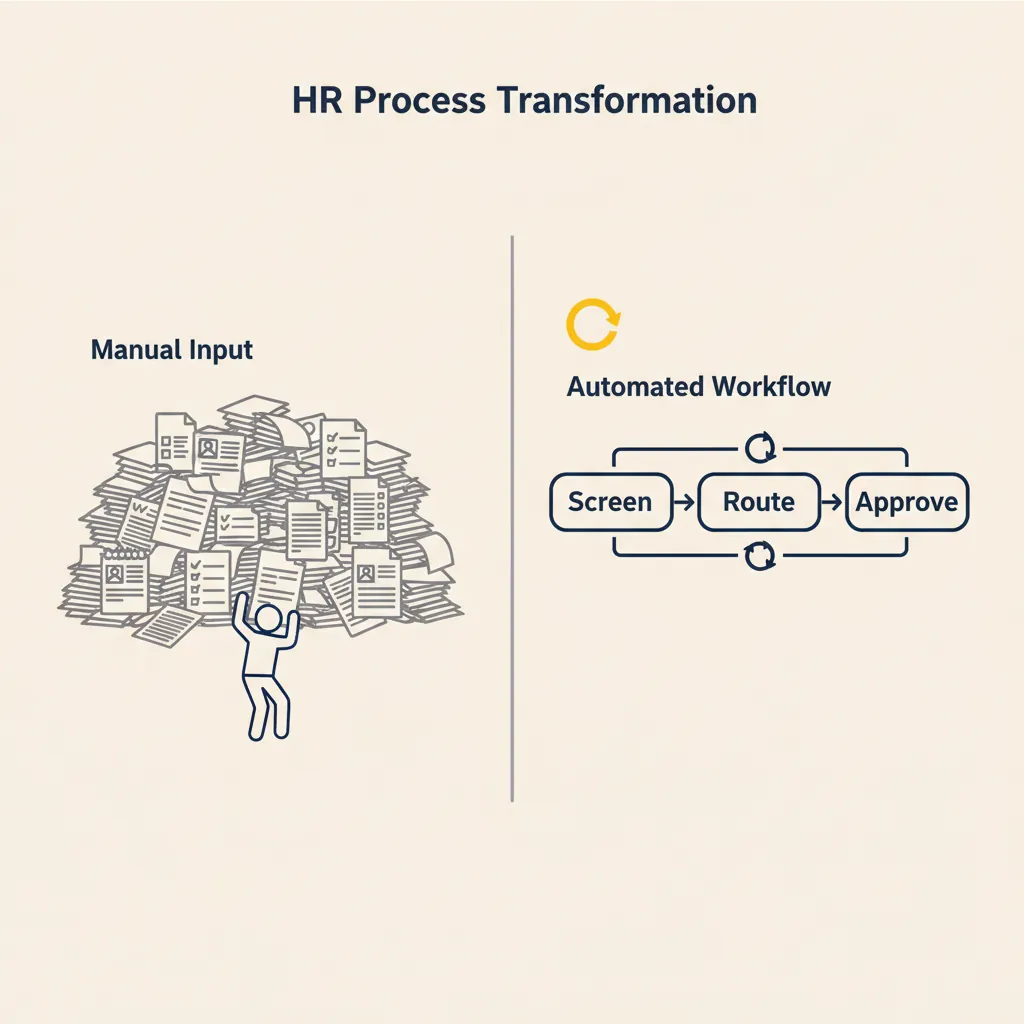
Your HR team drowns in leave requests, onboarding checklists, and the same employee questions every week. AI can take over those repetitive tasks, but only if you know which processes are genuinely suitable and how to stay GDPR-compliant in the Netherlands, much like the broader use of AI for businesses. In the projects we deliver for Dutch SMB HR afdelingen, we see that 65% of the work involves routine questions about leave balances, expense claims, and onboarding steps, all of which a chatbot or AI agent can handle. The trick is starting with one documented workflow, automating it, and then expanding once you've measured the hours you win back.
This guide walks you through which HR tasks you can automate with AI, what the Dutch regulatory framework (AVG, Works Council consent) demands, how to integrate with AFAS, Exact Online, or Nmbrs, and what a realistic budget and timeline look like for an SMB with 10 to 50 employees.
| HR domain | What AI automates | What stays human | Typical time saved per week |
|---|---|---|---|
| Recruitment | CV screening, first-contact emails, interview scheduling | Culture fit assessment, final hiring decision | 4-6 hours |
| Onboarding | Document collection, account provisioning, checklist reminders | Manager introduction, team integration | 2-3 hours per new hire |
| Employee queries | Leave balance lookups, policy FAQs, expense-claim routing | Sensitive conversations, conflict resolution | 5-8 hours |
| Performance management | Reminder emails, data collection, feedback summaries | Performance reviews, coaching, development plans | 2-4 hours |
Welke HR-taken kun je automatiseren met AI (en welke niet)?
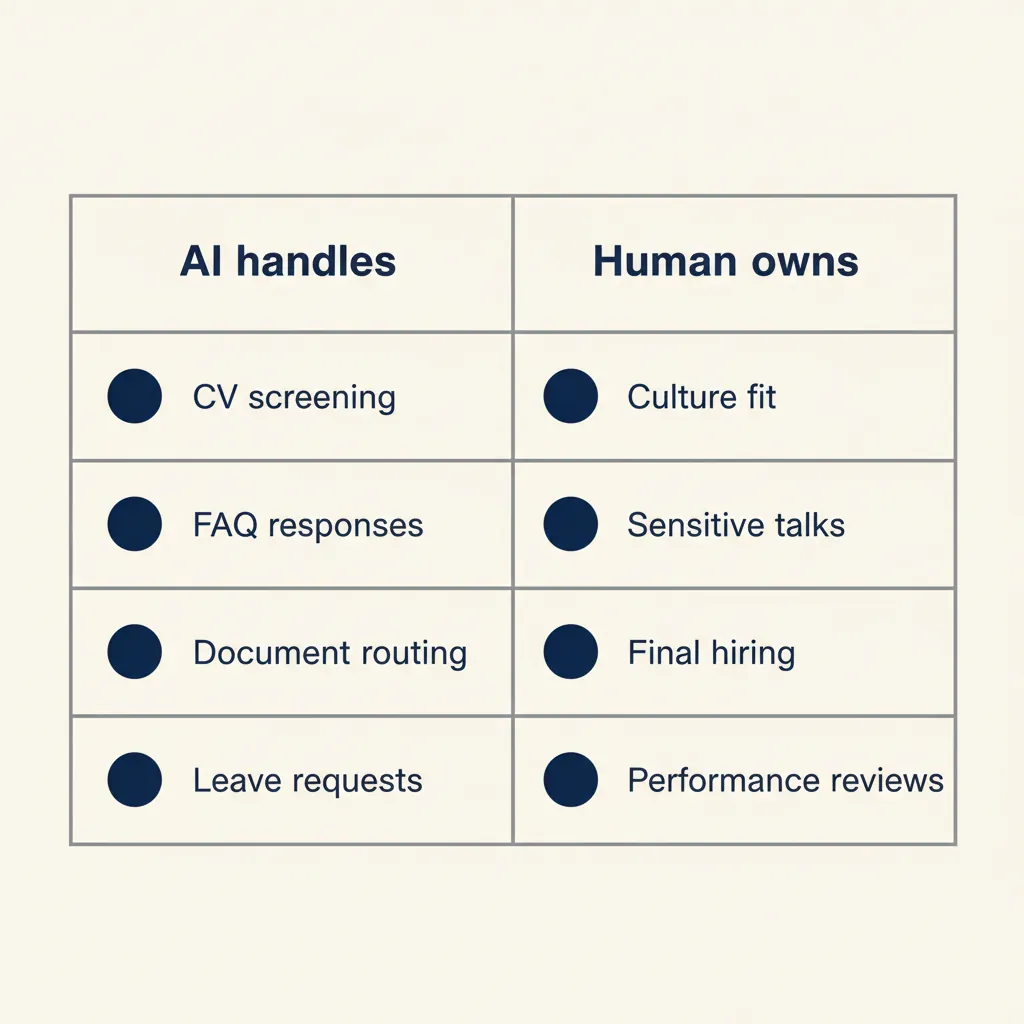
AI handles repetitive admin work well: CV screening, FAQ chatbots, onboarding document flows, and leave-request routing. Humans own culture fit, sensitive conversations, and final hiring decisions. The divide is simple: if the task follows a clear rule and repeats weekly, automate it. If it requires judgment, empathy, or company-specific context that changes per case, keep it human.
Recruitment: CV-screening en eerste-lijn kandidaatcontact
An AI agent can read incoming CVs, check them against your must-have criteria (years of experience, specific certifications, language skills), and sort candidates into yes/maybe/no buckets. It can also send a first-contact email to schedule a phone screen. What it cannot do: assess whether someone will thrive in your team culture or handle the nuance of a candidate who lacks one formal requirement but brings adjacent experience. In our AI agent work for Dutch SMBs, we see the biggest time win when clients have more than 10 vacancies per year; below that threshold, the setup effort often exceeds the payback.
Onboarding: documenten, accounts en checklists
Onboarding is a checklist-heavy process: collect signed contracts, ID copies, bank details, provision email and Slack accounts, assign training modules, send reminders on day 3, day 7, day 14. An AI workflow can trigger each step automatically when the previous one completes. For example, once the signed contract lands in your document folder, the workflow creates the employee record in AFAS or Exact Online, sends the IT team a ticket to provision accounts, and emails the new hire a welcome checklist. The manager still handles the personal introduction and team integration, but the admin overhead drops from 3 hours per hire to 20 minutes.
Medewerkersvragen: verlof, ziekte, declaraties
A chatbot that answers common employee questions (leave balance, sick-leave procedure, expense-claim form) can cut your HR coordinator's inbox by 60-70%. The bot pulls data from your HR system via API, so answers are always current. When a question falls outside its knowledge base (a complex parental-leave scenario, a conflict with a manager), it escalates to a human. We build these chatbots on top of n8n or Make, connected to AFAS, Exact Online, or Nmbrs, so the employee gets an instant answer and your team only sees the cases that genuinely need judgment.
Wat AI niet moet doen: cultuurfit, functioneringsgesprekken, ontslag
AI should never make the final call on hiring, performance reviews, or termination. These decisions carry legal and human consequences that require context, empathy, and accountability. An AI can summarize feedback or flag patterns in performance data, but the manager conducts the conversation and owns the outcome. Similarly, culture fit is too subjective and company-specific to delegate to an algorithm. Use AI to save time on the repetitive prep work, then apply human judgment to the decision itself.
What this means for you: Map which tasks your HR team does every week that follow a clear rule. Those are your automation candidates. Everything that requires interpreting tone, reading between the lines, or making a judgment call stays with your people.
AVG, Ondernemingsraad en bias: compliance voor Nederlandse HR-afdelingen
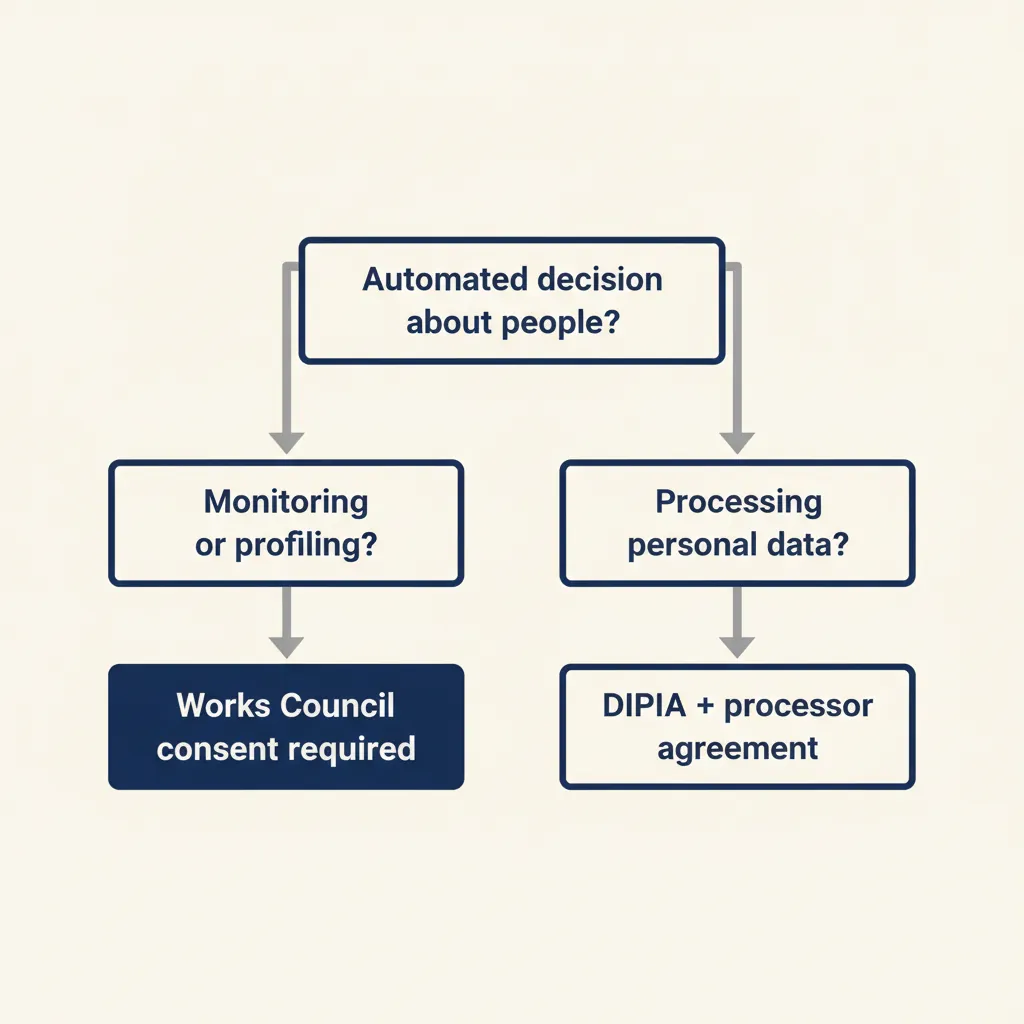
Most international AI-for-HR content ignores the Dutch regulatory layer. Under the AVG (the Dutch implementation of GDPR), any automated processing of employee or candidate data triggers specific obligations: transparency, purpose limitation, and often a Data Protection Impact Assessment (DPIA). If your company has a Works Council (Ondernemingsraad), certain AI decisions require formal consent before you deploy them. Ignoring these steps can result in fines from the Autoriteit Persoonsgegevens or a Works Council veto that halts your project.
Wanneer heb je een DPIA nodig?
A DPIA is mandatory when your AI system makes automated decisions that significantly affect individuals, or when you process sensitive personal data at scale. Concrete examples: CV screening that ranks candidates without human review, or a chatbot that logs every employee question and uses sentiment analysis to flag dissatisfaction. If you're only using AI to route leave requests or send onboarding reminders (no profiling, no automated rejection), a DPIA is often not required, but you still need a processing register entry. When in doubt, consult the Autoriteit Persoonsgegevens DPIA tool or work with a privacy officer.
Ondernemingsraad: welke AI-besluiten zijn instemmingsplichtig?
Under Dutch law, the Works Council has consent rights (instemmingsrecht) over any system that monitors or evaluates employee behavior. If your AI chatbot logs response times, tracks which employees ask which questions, or feeds data into a performance dashboard, you need Works Council approval before you go live. The same applies to CV-screening tools that automatically reject candidates based on algorithm-driven scores. Transparency is key: show the Council what data the system collects, how decisions are made, and what safeguards prevent bias. In the AI consultancy projects we run for Dutch SMBs, we recommend involving the Works Council early, during the design phase, rather than presenting a finished system and hoping for a rubber stamp.
Verwerkersovereenkomsten en data-locatie
Any AI vendor that processes employee or candidate data on your behalf is a processor under the AVG, and you need a signed processing agreement (verwerkersovereenkomst) that specifies data location, sub-processors, retention periods, and breach notification. If you're using a US-based chatbot platform, check whether they rely on Standard Contractual Clauses or the EU-US Data Privacy Framework. For maximum control, consider self-hosted options (n8n, for example, can run on a Dutch server) so employee data never leaves the Netherlands. When integrating with AFAS or Exact Online, verify that the AI tool's API connection is encrypted and that the vendor has a valid processing agreement in place.
What this means for you: Before you deploy any AI tool that touches employee data, map the regulatory checklist: do you need a DPIA, does the Works Council have consent rights, and does your vendor agreement cover AVG obligations? Skipping these steps can stall your project for months.
Running into this at your own business? We'll spend 30 minutes with you for free, no sales pitch. Book a free intro call
Koppeling met Nederlandse HR-software: AFAS, Exact Online, Nmbrs
Most Dutch SMBs run AFAS, Exact Online, or Nmbrs for payroll and HR administration. The good news: all three expose APIs that let you sync leave balances, employee records, and approval workflows with an AI chatbot or automation platform. The setup is straightforward when you use middleware like n8n or Make. For example, an employee asks the chatbot for their leave balance; the chatbot queries the AFAS API, retrieves the current balance, and replies in seconds. Or a new hire completes an onboarding form; the workflow pushes their data into Exact Online, creates a payroll record, and notifies the finance team.
What requires custom work: complex approval routing (leave requests that need manager approval, then HR approval, then payroll notification) and edge cases (part-time employees with prorated leave, employees on multiple contracts). In our business automation work, we build these workflows end-to-end, typically in 3 to 5 days of setup. The client owns the workflow code and can adjust approval rules or add new steps without vendor lock-in. The key is documenting your current process first: if you can't draw the approval flow in five boxes, the automation will inherit the same chaos.
What this means for you: If you're already on AFAS, Exact Online, or Nmbrs, integration with an AI chatbot or workflow tool is a matter of days, not months. The bottleneck is usually process clarity, not technical feasibility.
Wat de meeste AI-leveranciers verkeerd doen bij HR-automatisering
The anti-pattern we see repeatedly: a vendor sells you the chatbot or CV-scanner first, then discovers your approval process was never documented, leave policies live in someone's head, and onboarding steps differ per manager. The tool works fine in a demo, but when you try to connect it to your real workflow, it falls apart because the workflow itself is inconsistent. The fix is simple but unglamorous: map and clean the process before you automate it. Sit down with your HR coordinator and the managers who approve leave. Draw the current flow: who submits, who approves, what happens if the manager is on holiday, what happens for part-time employees. If you discover three different approval paths that no one documented, unify them first. Then automate the clean, agreed process.
A concrete example: a client came to us with a leave-request workflow that had three approval paths depending on the employee's contract type, but those rules were never written down. The HR coordinator knew them by heart, but the system didn't. We spent half a day mapping the logic, wrote it into a decision tree, and then built the automation in n8n. The chatbot now routes every leave request correctly, and the client can adjust the rules in the workflow editor without calling us. The rule of thumb we use: if you can't draw the process in five boxes, you're not ready to automate it.
What this means for you: Don't buy the AI tool first. Document your current process, identify the repetitive steps, and then pick the tool that fits. The automation is only as good as the process you feed it.
Kosten, doorlooptijd en ROI voor MKB (10-50 medewerkers)
A chatbot that answers employee FAQs (leave balance, sick-leave procedure, expense claims) typically costs €2,000 to €4,000 to build and €50 to €150 per month to run, depending on message volume and whether you self-host or use a cloud platform. Setup takes 1 to 2 weeks: one week to map the knowledge base and train the bot, one week to connect it to your HR system and test edge cases. If your HR coordinator currently spends 6 hours per week answering these questions, the bot pays for itself in 8 to 12 weeks.
CV-screening integration (an AI agent that reads incoming CVs, scores them against your criteria, and sorts them into yes/maybe/no) costs €3,000 to €5,000 to set up and takes 2 to 3 weeks, including the time to define your scoring rubric and test it on real CVs. Payback depends on hiring volume: if you process fewer than 10 vacancies per year, the manual effort is often lower than the automation cost. Above 20 vacancies per year, the ROI is clear.
Onboarding automation (document collection, account provisioning, checklist reminders) costs €2,500 to €4,500 and takes 1 to 2 weeks to build. If you hire 10 people per year and each onboarding currently takes your HR team 3 hours of admin work, you save 30 hours per year, or roughly one week of work. The workflow pays for itself in the first year and continues saving time every year after.
The threshold for when NOT to automate: if the task happens fewer than once per week, or if the process changes frequently and you don't have the time to document it, stick with manual work. Automation shines when the task is repetitive, high-volume, and stable. Start with one workflow, measure the hours you win back, and expand from there.
What this means for you: Budget €2,000 to €5,000 and 1 to 3 weeks for a single HR automation workflow. If your team spends more than 4 hours per week on the task, the payback is typically under 12 weeks.
AI for HR works best when you start with one repetitive process your team does manually right now, document it, and then automate it. Start small, measure the hours you win back, and expand once you've proven the ROI. The regulatory layer (AVG, Works Council consent, processor agreements) is not optional in the Netherlands, but it's also not a blocker if you address it upfront. And the integration with AFAS, Exact Online, or Nmbrs is straightforward when you use the right middleware. The bottleneck is almost never the technology; it's process clarity and the discipline to map before you automate.
For a related angle, see our post on n8n vs Make for SMB: which platform fits your team?.
Frequently asked questions
Mag je AI gebruiken voor CV-screening onder de AVG?
Yes, but you must ensure transparency (candidates know an algorithm is involved), human oversight (a person reviews the AI's recommendations before rejecting anyone), and often a DPIA if the system makes automated decisions that significantly affect individuals. Works Council consent is also required if the tool monitors or evaluates employee behavior.
Wanneer heb je toestemming van de Ondernemingsraad nodig voor HR-AI?
You need Works Council consent when the AI system monitors or evaluates employee behavior, such as logging chatbot questions, tracking response times, or automatically scoring performance. If the tool only routes leave requests or sends reminders without profiling, consent is typically not required, but transparency is still essential.
Welke HR-software integreert makkelijk met AI-tools?
AFAS, Exact Online, and Nmbrs all expose APIs that let you sync leave balances, employee records, and approval workflows with AI chatbots or automation platforms like n8n and Make. Setup typically takes 3 to 5 days, and the client owns the workflow code.
Hoeveel kost een AI-chatbot voor medewerkersvragen?
A chatbot that answers employee FAQs (leave balance, sick-leave procedure, expense claims) costs €2,000 to €4,000 to build and €50 to €150 per month to run. If your HR team spends 6 hours per week on these questions, the bot pays for itself in 8 to 12 weeks.
Kun je AI-automatisering zelf opzetten zonder IT-afdeling?
You can use no-code platforms like n8n, Make, or Zapier to build simple workflows yourself, but connecting to your HR system's API, handling edge cases, and ensuring AVG compliance usually requires a developer or consultancy. Most SMBs find it faster to hire a specialist for the first workflow, then adjust it themselves later.
Wat is het verschil tussen een AI-chatbot en een AI-agent voor HR?
A chatbot answers questions by retrieving information from a knowledge base or API. An AI agent can also take actions: it reads a leave request, checks the employee's balance, routes the request to the right manager, and updates the HR system once approved. Agents handle multi-step workflows; chatbots handle Q&A.
Sources
Curious what AI can do for your business?
We listen, think along, and quickly deliver something that works. No obligations, no pressure.